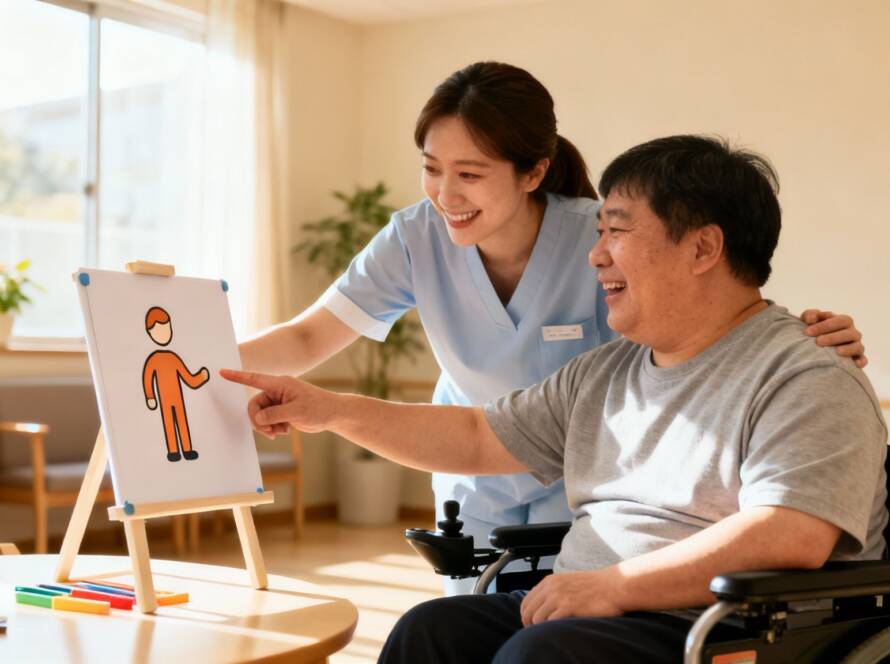
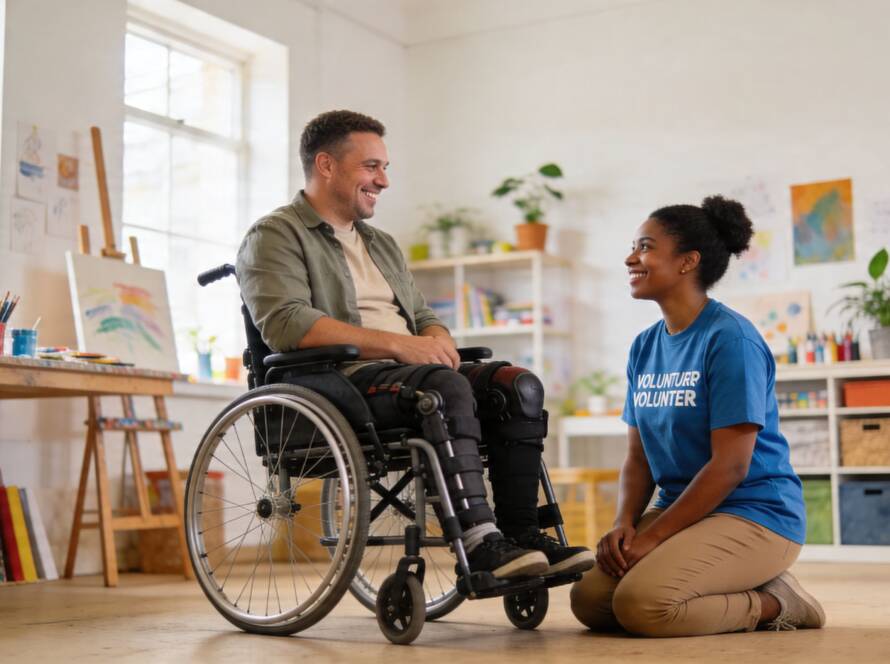
A member arrives anxious, quiet, and unsure whether to join in. Two hours later, they’ve made a collage, chosen a song for the group playlist, and asked staff if they can practise the bus route again next week.
That shift matters. Meaningful activities for adults with disabilities aren’t about keeping people occupied. They build confidence, create routine, strengthen communication, and turn abstract goals like “more independence” into everyday progress that can be seen in real situations.
This matters across the South too. In West Sussex, around 16% of residents were classified as disabled in Census 2021 data, including 10% whose disability limited them “a little” and 6.1% limited “a lot”, according to the West Sussex disability census briefing. Demand isn’t identical in every area, but the need for accessible, person-centred day opportunities is clearly substantial.
Good programmes don’t treat art, travel training, exercise, friendships, and work skills as separate boxes. They connect them. Someone might learn to budget during cookery, build confidence on a community outing, and then use those same skills in a supported work placement.
West Sussex already has a broad mix of provision, including county council Adult Learning Disability courses in Angmering, Burgess Hill, Littlehampton, and Worthing, alongside leisure activities, day services, specialist centres, and accessible physical activity coordinated through regional partnerships, as outlined by Active Sussex’s directory of activities in Sussex. That wider picture shows an important point. Adults need varied options, not one-size-fits-all sessions.
The ten activity areas below work best when they’re personalised, structured, and linked to real-life outcomes.
1. Art and Craft Therapy
Creative sessions often reach people who find direct conversation difficult. Painting, collage, clay, card-making, printing, and simple textile work give adults another way to express preference, mood, and identity without needing the right words on the spot.
What works is structure without rigidity. A clear starting point helps, but too much control can flatten the whole session. If every participant is pushed towards the same end product, staff usually get compliance rather than genuine engagement.

What makes creative sessions successful
The strongest sessions usually combine accessible tools with real choice. Easy-grip brushes, one-handed scissors, weighted utensils, pre-cut materials, table clamps, and non-slip mats can remove frustration before it starts.
A useful balance looks like this:
- Offer a choice of medium: Some people prefer paint, others prefer glueing, tearing, stamping, or arranging found materials.
- Reduce avoidable barriers: Pre-drawn outlines, adapted handles, and prepared materials help people focus on creating instead of struggling with setup.
- Show the finished work: Display boards, take-home folders, and family photos of completed pieces reinforce achievement.
Practical rule: Don’t mistake a neat result for a good session. A successful session is one where the person made choices, stayed engaged, and felt ownership.
At services such as The Grow Project’s day opportunities for adults with learning disabilities, arts and crafts sit well within a wider timetable because they can support fine motor skills, attention, communication, and confidence all at once. They’re also flexible. One person may enjoy careful, repetitive beadwork; another may prefer bold painting with music on in the background.
What doesn’t work is rushing. Creative work needs enough time for set-up, experimentation, and a calm finish. If sessions are squeezed between transport, medication, and lunch with no breathing room, many adults disengage before they’ve really begun.
2. Supported Employment and Social Enterprise
I’ve seen the shift happen in a single morning. Someone who arrives unsure, quiet, and waiting for direction stands differently once their task has a real destination. Pack the order correctly, water the plants that will be sold this afternoon, label the jars for the farm shop, wipe down the prep area before the next team starts. The work is concrete, and that changes how many adults see themselves.
Supported employment works best when the activity has a clear purpose and a clear fit. In practice, that means matching the person to the task, not squeezing everyone through the same routine. An adult who likes repetition and accuracy may settle well into packing, sorting, checking stock, or basic admin. Someone who enjoys contact with others may do better greeting visitors, serving customers, helping on a stall, or supporting simple deliveries with staff nearby.
At The Grow Project, practical enterprise activity often grows naturally from land-based work. Tasks linked to farming experience days that build routine, responsibility, and teamwork can become a bridge to wider work habits because people are contributing to something that continues beyond the session.
That link matters. In many services, public information about activities still leans heavily toward hobbies and recreation. In day-to-day practice, adults also need chances to build employability, money handling, stamina, communication, and task completion in ways that can be observed and reviewed.
A useful pathway usually includes:
- Low-pressure starting points: Internal jobs, volunteering tasks, or short supported roles help staff see what support level is needed.
- Clear workplace expectations: Start times, break routines, hygiene, dress, and task steps need to be taught directly.
- Real outcomes: Products get sold, tables get set, stock gets counted, and customers get served. Adults notice when work has genuine value.
- Linked independence goals: Travel training, budgeting, and safe mobility planning often determine whether a work goal is realistic. For some adults, the right equipment also affects whether they can access community-based roles consistently, which is why families sometimes explore Affinity Medical mobility solutions.
Paid employment is not the only marker of success.
Some adults want a job. Some want structure, responsibility, and a role that feels adult without the pressure of open employment. Both are valid. A good programme measures progress by looking at attendance, timekeeping, endurance, confidence with instructions, social interaction, problem-solving, and how much support can gradually be reduced.
The main pitfall is token work. Folding paper for no reason or repeating made-up tasks may fill time, but it rarely builds pride or transferable skill. Useful supported employment gives adults a reason to show up, a role in a team, and evidence that their contribution matters.
3. Community Outings and Environmental Access
A good community outing isn’t a minibus ride and a coffee stop. It’s a planned chance to use skills in practical settings. Ordering food, waiting in a queue, using money, managing noise, making choices, and recovering from small changes in plan are all part of it.
That’s why local access matters so much. A park visit, library trip, farm day, gallery stop, or café lunch can all become practical learning if staff know what they’re trying to support.
Making outings useful, not chaotic
Preparation makes the difference. Adults usually cope better when they know where they’re going, who’s going, how long they’ll be out, and what to do if something changes. Visual schedules, venue photos, spending prompts, and a simple plan for toilets, seating, and quiet space all reduce stress.
Trips connected to outdoor learning can be especially effective. The Grow Project’s farming experience days show how outings can combine movement, sensory input, teamwork, and practical responsibility rather than being treated as one-off treats.
The best outings usually include these elements:
- A purpose: Buying ingredients, borrowing library books, visiting animals, or practising a bus route gives the trip shape.
- A social target: Staff can encourage one person to order independently, greet a cashier, or ask a simple question.
- A review afterwards: A short debrief helps capture what went well and what needs more support.
For adults using wheelchairs or scooters, route planning and equipment reliability can shape the whole experience. That’s where practical suppliers and maintenance support matter, including Affinity Medical mobility solutions, because a community activity stops being inclusive the moment mobility access is treated as an afterthought.
Community presence is a skill in itself. People become more confident in public by being in public, repeatedly, with the right support.
What doesn’t work is overprotecting people to the point that staff do everything for them. If the worker orders the drink, carries the bag, speaks for the person, and rushes every transition, the outing becomes passive.
4. Physical Activity and Adaptive Fitness
I’ve seen adults arrive at a movement session expecting to fail before we even begin. They have often spent years hearing about risk, limitations, and what needs to be avoided. A good session starts by changing that expectation. The aim is not to copy a standard exercise class. The aim is to help the person feel safe enough to try, repeat, and notice progress.

Physical activity works best when it is tied to whole-person outcomes. Better balance can mean safer transfers. Greater stamina can mean staying out longer in the community. Improved shoulder strength can support dressing, cooking, or wheelchair use. For some people, the biggest outcome is emotional. They become more willing to join in, recover from setbacks, and trust their own body again.
The difference between inclusive and performative fitness
Inclusive fitness adapts the session around the person’s communication, mobility, sensory profile, confidence, and health needs. Staff break instructions into clear steps, offer seated and standing options, build in rest points, and watch for signs of fatigue or overload. Success is measured by participation, consistency, and function in daily life, not by how closely someone matches a non-disabled exercise model.
In practice, that can include seated circuits, resistance bands, dance-based movement, stretching, wheelchair skills, supported walking, light balance work, or simple movement games set to familiar music. At The Grow Project, this kind of activity is usually most effective when it sits inside a predictable routine and has a clear purpose. People attend more regularly when they know what the session will feel like, who will be there, and what “doing well” looks like for them.
The trade-off is real. Push too hard and people disengage. Keep things too easy for too long and progress stalls.
What usually helps is a simple structure such as:
- Routine before intensity: Short, repeated sessions often build more confidence and fitness than occasional ambitious ones.
- Choice in how to join: Some adults start with one-to-one support, then move into a small group when they feel ready.
- Visible progress measures: Track practical outcomes such as standing tolerance, range of movement, recovery time, coordination, or willingness to take part.
- Adapted sensory input: Music, quieter spaces, reduced waiting time, and predictable transitions can make the difference between participation and refusal.
Low-impact formats are often the most sustainable, especially for adults managing pain, fatigue, balance difficulties, or anxiety about exercise. For session ideas, affordable connectivity program details can sit alongside simple low-tech prompts, and generic guides to sustainable low-impact movement can offer staff a starting point for adapting activities without overcomplicating them.
What does not help is turning exercise into compliance work. If staff present movement as punishment, weight control, or something a person must tolerate, attendance usually drops. People keep coming back when sessions feel achievable, social, and connected to everyday independence.
5. Digital Inclusion and Online Safety
Last winter, one of our adults arrived upset because a stranger had messaged her for money. She had done what many people do under pressure. She clicked quickly, felt unsure, and then felt embarrassed. We did not turn that into a lecture. We turned it into a teaching plan.
That is usually the turning point with digital inclusion. Phones and tablets are part of adult life now, but access on its own does not build independence. Adults need repeated practice with the jobs they want to do, such as sending a voice note, joining a video call, checking a bus time, saving a trusted contact, or spotting a message that does not feel right.
At The Grow Project, digital sessions work best when they stay tied to real outcomes. The aim is not "using tech" in the abstract. The aim is clearer communication, safer decision-making, better access to community life, and more control over daily routines. Those are whole-person outcomes, and they can be tracked. Staff can measure whether someone can log in with less prompting, identify a scam message, use privacy settings, or ask for help before responding to an online request.
Teaching digital skills in a way people can retain
One device, one task, one safety rule is often enough for a session. Adults remember more when the lesson is narrow and practical. A person learning to make a video call may also practise one linked safety step, such as checking they are calling a known contact. Someone learning online shopping may focus on recognising secure payment steps and stopping before sharing bank details.
Short sessions usually beat long ones here. Attention drops quickly once instructions pile up, especially for adults who are processing language slowly, managing anxiety, or working with limited memory. Staff need to judge the trade-off carefully. Too much support can create dependence, but too little can leave the person exposed to mistakes they do not yet know how to repair.
What tends to help:
- Printed visual prompts: Screenshots with simple labels help adults repeat the task later.
- Side-by-side practice: Staff model first, then reduce prompts in stages.
- Direct safety teaching: Privacy, passwords, consent, photos, location sharing, and online relationships need plain language discussion.
- Error recovery practice: Adults need to know what to do if they click a suspicious link, lose a password, or receive an upsetting message.
Access still matters. Some adults are ready to learn but do not have reliable internet at home, enough data, or a suitable device for practice between sessions. In those cases, staff may need to discuss practical options with families, including schemes such as affordable connectivity program details.
A common mistake is assuming regular phone use equals digital understanding. It does not. Someone may scroll confidently and still be unsure about scams, boundaries, or what information should stay private. Good digital support treats online safety as a life skill, not a one-off warning.
6. Food Preparation and Healthy Habits Education
Cookery sessions are rarely just about food. They bring together planning, sequencing, hygiene, sensory tolerance, turn-taking, budgeting, and communication in one practical activity.
That’s why they work so well in day services. Adults can chop, stir, wash up, read picture recipes, compare prices, choose ingredients, and then share what they’ve made. The session feels purposeful because the result is immediate.
Why cookery teaches more than cooking
Simple recipes are usually the strongest place to begin. Sandwich fillings, wraps, pasta salads, tray bakes, fruit pots, soups, toast toppings, and no-fuss baking all allow room for repetition and success. Complicated recipes with lots of timings often create unnecessary pressure.
The value grows when healthy habits are built in naturally rather than delivered as a lecture. Staff can talk through handwashing, fridge storage, portion awareness, trying new foods, and how to build a simple meal. Adults tend to retain more when the discussion happens during the task.
A good cookery session ends with more than a plate of food. The person should leave knowing one step they can repeat elsewhere.
What tends to help most:
- Picture-led recipes: Short visual instructions reduce reliance on memory and reading.
- Adapted equipment: Lightweight bowls, angled knives, ergonomic peelers, and non-slip mats widen participation.
- Real-life carryover: Shopping lists, packed lunch planning, and budgeting tie the activity to home routines.
What doesn’t work is overcomplicating “healthy eating” until it becomes abstract. People usually respond better to practical messages such as choosing a balanced lunch, drinking enough, or learning one reliable meal they can help make at home.
7. Public Transport Training and Independent Travel
One of the clearest shifts I see in day services happens at the bus stop. A person who needed a lift for every session starts recognising the route, checking the sign, showing their pass, and arriving with less support. That change is practical, not symbolic. It often affects attendance, confidence, access to work placements, and how much choice a person has in their own week.
Independent travel is a whole-person skill. It draws on communication, time awareness, emotional regulation, road safety, money skills, and the ability to manage small changes without shutting down. At The Grow Project, travel training works best when it is tied to a real destination that matters to the person, such as coming to a session, reaching a work experience placement, or getting to a preferred community activity.

What good travel training looks like in practice
The strongest starting point is usually one short, repeatable route at a quiet time of day. Staff teach the route in the same order each time, using the same cues, until the person can predict what comes next. That might include identifying the right stop, noticing the number on the bus, asking for help, choosing where to sit, pressing the bell, and leaving safely.
Useful supports are simple and specific. A laminated route card, photos of landmarks, colour-coded prompts, and a phone plan for emergencies often help more than long verbal explanations. Clear rehearsal also matters. People need practice with ordinary problems such as a late bus, a cancelled journey, a busy vehicle, or a driver who speaks quickly.
A structured sequence often includes:
- Supported journeys: Staff model each step and explain decisions out loud.
- Shared responsibility: The adult takes on key parts of the route, such as spotting the stop or showing a pass.
- Reduced prompting: Staff stay nearby but step in less often as consistency improves.
- Safety rehearsal: The person practises what to do if plans change, they feel unsure, or they miss their stop.
There are real trade-offs here. Full independence is not the right goal for every adult, and pushing too fast can reduce confidence rather than build it. Some people travel well with a familiar route but struggle if the timetable changes. Others can manage the journey itself but still need support with waiting safely, using a phone, or coping with sensory overload. Good programmes measure success by safer access and greater choice, not by withdrawing support before the person is ready.
This is also why family and staff consistency matters. If one team member prompts every step and another expects full recall, progress becomes uneven. The broader principles in how to support adults with learning disabilities apply strongly here, especially around predictable communication, risk awareness, and building independence in stages.
One successful trip is a start. Real progress shows up when the person can repeat the route, recover from minor setbacks, and use that skill to take part in more of everyday life.
8. Friendships, Relationships, and Social Skills Education
A group room can be full, noisy, and friendly on the surface, yet one adult may still leave without having a real conversation. I see that often. Attendance alone does not build friendship skills, relationship judgement, or confidence with boundaries.
Many adults need direct teaching on starting conversations, reading body language, respecting personal space, understanding consent, and knowing the difference between public and private behaviour. That teaching has to be age-appropriate and honest. Adults deserve clear information without being patronised, and they also deserve time to practise in ways that feel safe.
At The Grow Project, we treat this as whole-person work, not a one-off discussion about “being social.” If someone wants more friends, a boyfriend or girlfriend, better group participation, or less conflict at home, we link sessions to practical outcomes. Can they greet someone appropriately, spot when a conversation has gone too far, ask for space, repair a minor disagreement, or say no clearly? Those are measurable skills. They affect safety, confidence, and independence.
Good relationship education covers opportunity as well as risk. Adults often want support with friendship groups, dating, texting, online contact, gossip, jealousy, and rejection. They also need clear teaching about pressure, manipulation, unwanted touch, and their right to change their mind. The balance matters. Too much focus on danger can make people withdraw. Too little leaves people exposed.
The work is stronger when staff and families use the same language and expectations. Mixed messages create confusion quickly, especially around privacy, affection, or what counts as appropriate contact. That is why this area often sits alongside broader support for adults with learning disabilities in day services and everyday routines, where communication, boundaries, confidence, and consistency can be taught together.
Useful methods include:
- Role-play with realistic scripts: Practise greetings, turn-taking, checking if someone is busy, and ending a conversation politely.
- Scenario discussion: Use real-life situations about messages, rumours, dating, arguments, or being left out of a group.
- Visual rules and social stories: Make abstract ideas such as consent, privacy, and mutual respect easier to understand.
- Supported practice in ordinary settings: Shared activities, break times, and community sessions give people a chance to use the skill straight away.
There are trade-offs here as well. Some adults enjoy role-play and learn quickly from it. Others find it embarrassing and do better with short coaching in real situations. Some can explain a rule in the room but struggle to apply it when emotions rise. Progress should be judged by what the person can use in everyday life, not by whether they can repeat the right words in a session.
One of the clearest signs that this work is helping is generalisation. The adult starts using the skill in more than one setting, with more than one person, and with fewer prompts. That is where social education starts to support real independence.
9. Life Skills and Independent Living Preparation
On a Tuesday morning, one man in our service spent 20 minutes working out what to pack for the day. Wallet, keys, lunch, phone, travel card. A year earlier, staff would have packed the bag for him to keep the morning moving. The bag got packed, but he learned very little from it. That is the trade-off in life skills work. Doing tasks for someone is often quicker. Teaching them to do it themselves is slower, messier, and far more useful.
Life skills preparation matters because it affects ordinary decisions across the whole day. Can the person get ready on time, keep track of belongings, use money safely, store food properly, and notice when something has gone wrong at home? Those outcomes are easier to measure than a vague aim such as “more independence”, and they tell staff and families whether support is effective.
At The Grow Project, we usually get better results when these skills are taught in context rather than as isolated table-top tasks. That fits with broader support for adults with learning disabilities in structured day services, where routines, communication, confidence, and practical problem-solving can be built into the same week.
Building skills people can use at home
Useful targets are concrete and observable. “Put clean clothes away using drawer labels.” “Check the date on milk before making tea.” “Follow a five-step cleaning routine for the bathroom sink.” “Count out the right coins for a snack and check the change.” Staff can record prompts, accuracy, and whether the person can repeat the task in another setting. That gives a clearer picture of progress than a general note saying someone “engaged well”.
Useful approaches include:
- Task analysis with visual supports: Break one job into small steps so the adult can start, continue, and finish with less verbal prompting.
- Practice with real items: Laundry, cupboards, toiletries, money, bus passes, calendars, and kitchen equipment are better teachers than worksheets alone.
- Routine-based repetition: The same skill needs to appear again in the next session, and then again in a different context, or it usually drops away.
- Prompt fading: Move from full support to gesture, then to a visual cue, then to independent completion where possible.
- Error-friendly teaching: Let the person notice a missed item, an untidy shelf, or the wrong coin count, then support them to correct it.
Some adults make quick gains with checklists and picture labels. Others find visual systems cluttered or infantilising and do better with spoken prompts, colour coding, or practicing the task in the exact place they will use it. Person-centred work means choosing the method that helps the adult succeed, not the one staff happen to prefer.
Money awareness is often a turning point. It links daily living to choice, routine, and work-related responsibility. A person who can recognise value, track small spending decisions, and understand what money is for has more control over everyday life. In practice, that may start with handling coins for café purchases, matching prices to items, or checking whether enough money is left for the return journey.
Overhelping gets in the way. If staff fix every error before the person sees it, there is no chance to build sequencing, judgement, or recovery skills. Good support leaves room for safe mistakes, then uses them as part of learning.
The strongest sign of progress is carryover. The adult uses the skill in more than one place, with fewer prompts, and with more confidence. That is when life skills work stops being an activity on the timetable and starts improving daily independence.
10. Music Therapy and Sound-Based Activities
One of the clearest moments I see in a day service is when a room settles because the right song starts. A person who has struggled to join a discussion may tap the beat straight away. Someone else who arrived anxious may slow their breathing, look up, and stay with the group. That is why music keeps its place in a whole-person programme. It can support regulation, communication, confidence, and social connection in the same session.
Music works well because participation can look different from one adult to the next. One person sings every word. Another chooses between two tracks using pictures or a device. Another keeps time with a shaker for ten seconds, then needs a break. All of those responses count. In practice, the useful question is not whether the person is being musical. It is what skill or outcome the activity is helping them build.
When music becomes purposeful
At The Grow Project, the strongest music sessions have a clear aim. We might use a predictable welcome song to support anticipation and group entry, drumming to practise waiting and turn-taking, or familiar lyrics to prompt memory and conversation. For some adults, sound-based work is mainly about sensory regulation. For others, it is a route into choice-making, attention, movement, or shared enjoyment.
That difference matters. A lively group singalong can build belonging, but it can also overwhelm someone with sensory sensitivities. Quiet listening with headphones can reduce distress, but it offers less opportunity for peer interaction. Good planning weighs those trade-offs instead of assuming one format suits everyone.
A practical setup often includes:
- Clear purpose: match the session to a target such as communication, emotional regulation, coordination, or social participation.
- Real choice: offer familiar songs, calming sounds, percussion, keyboards, chimes, or voice-based activities, then notice what the person returns to.
- Accessible equipment: place instruments on trays, tables, wheelchair-accessible stands, or use adapted grips and switches where needed.
- Sensory pacing: plan volume, tempo, and session length carefully. Build in breaks, quiet options, and a clear finish.
- Observable outcomes: record whether the adult initiated a choice, tolerated the group for longer, took turns, matched rhythm, or used sound to express a feeling.
The point is participation with purpose.
Technology can help here too, especially for adults who respond well to recorded sound, visual music cues, or simple cause-and-effect apps. As noted earlier, access to tech-enabled creative activities is still uneven. In day services, that usually means starting with low-cost options that staff can run reliably, rather than buying equipment that ends up in a cupboard because no one has time to set it up well.
What does not work is forcing the same genre, volume, or level of interaction on everyone. Person-centred music support means noticing who needs energy, who needs structure, and who needs less sound, more space, and permission to join in their own way. When that fit is right, music stops being filler on the timetable and starts producing outcomes people can feel in daily life.
Comparison of 10 Activities for Adults with Disabilities
| Program | Implementation complexity | Resource requirements | Expected outcomes | Ideal use cases | Key advantages |
|---|---|---|---|---|---|
| Art and Craft Therapy | Low–Medium: structured sessions with adaptable tasks | Low-cost materials, workspace, storage, occasional adaptive tools, facilitator | Improved self-expression, fine motor skills, confidence, tangible portfolio | Non-verbal communication needs, motor-skill development, therapeutic expression | Accessible, low-cost, non-verbal outlet, measurable creative outcomes |
| Supported Employment and Social Enterprise | High: individual job coaching and employer partnerships | Significant staff time, employer liaison, transport support, ongoing supervision | Work experience, employability skills, income, social inclusion | Vocational pathways, supported transitions to paid/voluntary work | Genuine employment opportunities, financial independence, community integration |
| Community Outings and Environmental Access | Medium–High: planning, risk assessment and venue liaison | Staff support, transport, venue relationships, contingency planning | Community integration, real-world skills, reduced isolation, confidence | Practising life skills in public, social participation, community access | Direct community engagement, varied learning contexts, confidence-building |
| Physical Activity and Adaptive Fitness | Medium: programme adaptation and specialist knowledge | Adaptive equipment, trained instructors, accessible venues, assessments | Improved fitness, mobility, mood, stamina, social bonds | Health improvement, rehabilitation, group exercise and recreation | Strong physical and mental health benefits, motivating group activity |
| Digital Inclusion and Online Safety | Medium: ongoing training plus safeguarding frameworks | Devices, adaptive tech, connectivity, staff expertise, policies | Digital literacy, independent communication, access to resources, work pathways | Reducing isolation, remote employment prep, family contact | Essential modern skills, broad access to information, supports independence |
| Food Preparation and Healthy Habits Education | Medium: safety protocols and accessible facilities | Accessible kitchen, adaptive utensils, food budgets, supervision | Independent living skills, nutrition awareness, confidence in cooking | Preparing for independent living, budgeting, social meal participation | Tangible daily-living skills, promotes health, directly supports autonomy |
| Public Transport Training and Independent Travel | High: repeated real-world practice and safety planning | Extensive staff time, training materials, travel costs, risk management | Independent travel, increased access to employment and social activities | Those aiming for independent community access and employment commutes | Enables genuine independence, cost-effective long-term, measurable milestones |
| Friendships, Relationships, and Social Skills Education | Medium–High: sensitive facilitation and safeguarding | Trained facilitators, role-play resources, safe discussion spaces | Improved social confidence, relationship skills, reduced loneliness | Building social networks, relationship education, peer support | Enhances wellbeing, builds self-advocacy, improves real-world interactions |
| Life Skills and Independent Living Preparation | Medium: broad skill set training and home coordination | Realistic practice settings, adaptive supports, staff coaching, liaising with carers | Self-care, household management, budgeting, measurable independence gains | Transition to independent or semi-independent living, reducing care needs | Concrete, measurable outcomes that support autonomy and reduce support costs |
| Music Therapy and Sound-Based Activities | Low–Medium: activity-based or therapist-led approaches | Adaptive instruments, acoustic space, trained music therapist for clinical work | Emotional expression, communication, motor coordination, social bonding | Emotional regulation, non-verbal communication, group engagement | Highly accessible, motivating, strong emotional and social benefits |
Putting It All Together Your Path to Empowerment
The best activities for adults with disabilities don’t sit in isolation. Art supports communication. Cookery supports sequencing and health. Community outings strengthen confidence in public. Travel training makes other opportunities reachable. Supported work builds responsibility and routine. Music and movement can enable participation for adults who struggle in more verbal sessions.
That whole-person approach matters because progress is rarely linear. An adult might first engage through music, then begin talking more in friendships sessions, then feel ready for a café outing, and later manage part of a bus journey with reduced support. Each activity reinforces the next when staff plan them as connected experiences rather than separate timetabled slots.
Commissioners, carers, and support teams often ask what “good outcomes” look like in practice. They usually look ordinary. A person starts making choices more clearly. They tolerate change better. They greet others more confidently. They handle money with fewer prompts. They begin to travel with support instead of being escorted door to door. They take pride in a task that has a real purpose.
The most useful programmes also respect trade-offs. Not every adult wants a busy social timetable. Not every group session is the right fit. Some people need repetition rather than novelty. Others need challenge to avoid disengaging. Person-centred support means adjusting the pace, format, environment, and expectations without lowering respect.
For families, one of the clearest signs that a programme is working is carryover beyond the session itself. Skills begin appearing at home, in shops, on transport, or in community settings. A person starts asking to do things rather than waiting to be led through them. That’s where activity becomes meaningful development.
The Grow Project is one example of a weekday day service using that integrated model in Southampton and Littlehampton. Its programmes include arts and crafts, digital inclusion, employability and money skills, food preparation, friendships and relationships education, outdoor excursions, physical activity, and public transport training for adults with learning and physical disabilities. The value in that kind of model is the connection between activities and real-life independence.
Choosing the right support often comes down to one question. Does the activity help the person live a fuller life on their own terms? If the answer is yes, it’s worth building into the week.
For families, professionals, and adults looking for structured weekday support, The Grow Project offers person-centred activities that build confidence, friendships, and independence across Southampton and Littlehampton. It’s a practical option for those seeking a safe, welcoming service where meaningful daily activity connects to real-life goals.